Hazards Mountain Range
Morning light on mountains
Capture the granite peaks from the water to contrast the rugged rock faces against the deep blue Tasman Sea.

Almost every image of this beach that circulates online was shot from one place: the granite saddle between Mount Amos and Mount Mayson. Boat decks produce something different — a low, horizontal frame with the Hazards rising behind rather than falling away below. This wineglass bay cruises photos guide sets out what that difference means before anyone commits a morning to it.
Quick answer
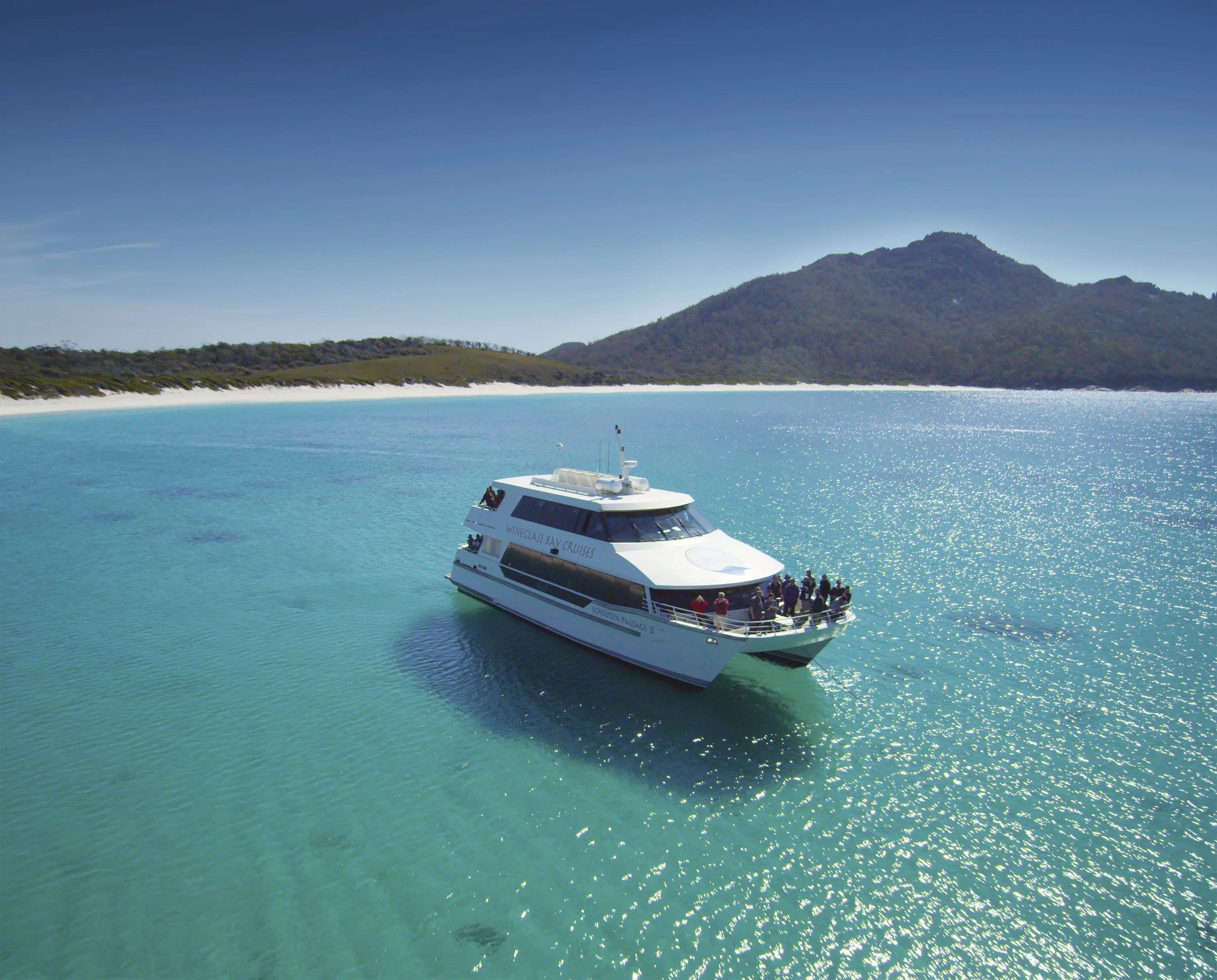
Boat-deck images of Wineglass Bay show the crescent at sea level, framed by pink granite headlands rather than seen from above. Access to Freycinet National Park costs 47.7 AUD (daily pass per vehicle, up to 8 people), and the park gate is open 00:00–23:59 daily. Vessels rarely land, so the beach itself stays a distant white line.
The pink in the Hazards is not lichen or light. It is orthoclase feldspar inside granite roughly 400 million years old, and it holds its colour whether the sun is out or not. That single geological fact shapes almost every frame taken from the water. From a boat, the granite is a wall at eye height; from the saddle track above, it is a foreground you look past. Anyone comparing wineglass bay cruises photos with lookout shots is really comparing two different subjects that happen to share a name. What a vessel offers is the eastern approach through Great Oyster Bay and around Cape Tourville, past sea caves, dolerite columns and the resident fur seal colony at Ile des Phoques on longer runs. White-bellied sea eagles nest along these cliffs. Bottlenose dolphins work the bow wave. None of that appears in a Freycinet boat tour frame taken from the granite saddle, and none of it can be reached on foot. The trade-off is the beach itself, which stays offshore — a thin white arc read across water rather than a crescent seen whole. Operators do not land passengers on the sand, so the classic overhead crescent belongs to the walking track, not the deck. Motion is the practical constraint. Swell in the Tasman Sea moves a hull constantly, and the shutter speeds that freeze a horizon are not the ones most phone cameras choose by default. Salt spray coats a lens within minutes on an open bow. Experienced passengers keep a microfibre cloth in a pocket, brace against a rail rather than a seat, and shoot far more frames than they expect to keep. Those planning a Freycinet Peninsula cruise for images specifically should also accept that weather cancels trips more often than any other factor on this coast. The park fee and gate times sit in the sections below, alongside timing and access detail. Read them together: a boat departure and a park entry are separate decisions, and many visitors do both in one day. Treated as reconnaissance rather than a gallery, wineglass bay cruises photos serve a second purpose — they show which headlands, which coves and which Tasmania coastal landmarks are worth returning to on foot afterwards.
“The pink in the Hazards is not lichen or light — it is feldspar, and it holds its colour whether the sun is out or not.”
Morning light on mountains
Capture the granite peaks from the water to contrast the rugged rock faces against the deep blue Tasman Sea.
Wineglass Bay white sand beach
Focus on the contrast between the white quartz sand and the turquoise water line from the cruise vessel deck.
Wineglass Bay cruise boat perspective
Shoot forward from the bow to frame the coastline and the approaching bay entrance for a sense of motion.
Ile Des Phoques seal colony
Photograph the granite rock formations inhabited by local seal colonies, often a highlight during the coastal transit.
The best arrival window is 09:00–11:00 to avoid midday crowds and heat, while providing optimal sunlight for coastal photography. Planning your cruise during shoulder seasons ensures favorable lighting and manageable visitor numbers.
Warm with temperatures 15°C–23°C
Long daylight hours provide extended opportunities for coastal landscape photography.
Mild with temperatures 10°C–18°C
Clear skies and steady light characterize this period, ideal for capturing water clarity.
Cool with temperatures 9°C–17°C
Wildflowers are in bloom, offering additional foreground interest for photographers.
—
Arriving during the 09:00–11:00 window minimizes shadows and provides the clearest view of the bay.
Verdict: For the best balance of light and visitor density, visit during weekdays in April or October, arriving between 09:00–11:00.
Everything you need to know about wineglass bay cruises photos
Wineglass Bay Cruise Reviews
Read more Tickets & toursWineglass Bay and Freycinet Peninsula Cruise with Lunch
Read more Tickets & toursWineglass Bay Shared Cruise and Walking Tour
Read more GuideCan You Drive to Wineglass Bay?
Read more Tickets & toursWineglass Bay Cruise from Hobart
Read more Tickets & toursWineglass Bay Cruise from Coles Bay
Read more GuideWineglass Bay Cruise Prices
Read more